
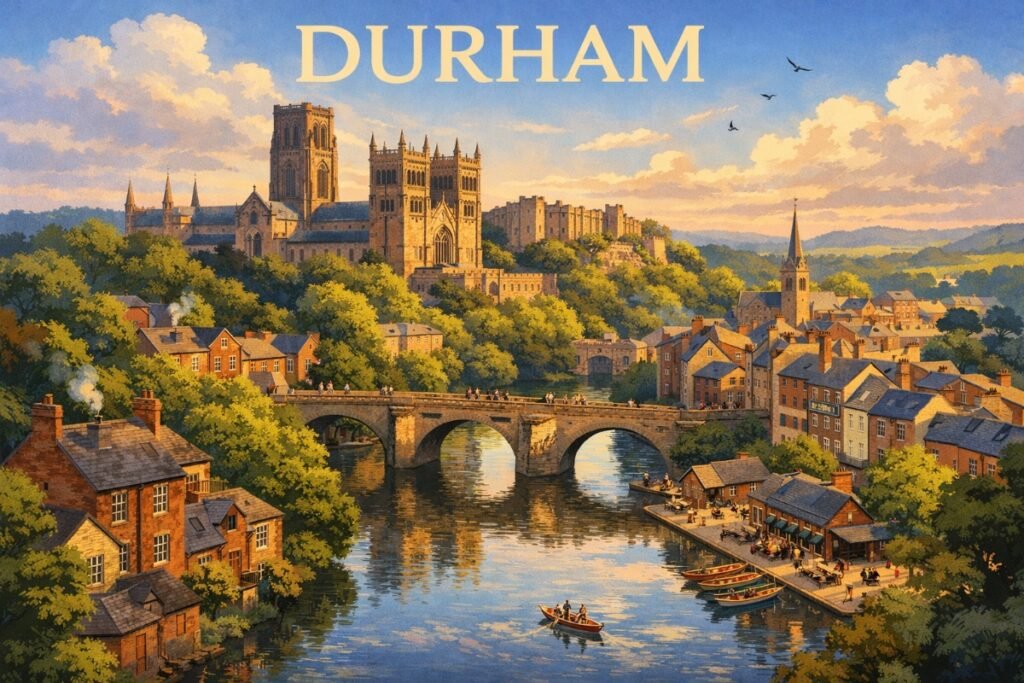
Discover Durham UK with our detailed guide covering its location, attractions, County Durham, and everything you need to know about Durham University.
Durham is one of England’s most historic and visually striking destinations, yet it remains one of the most frequently misunderstood. Is Durham a city or a county? Where exactly is it on the map? What makes it worth visiting? And how does Durham University rank among the UK’s best?
This comprehensive guide answers every common question about Durham, from its precise location in North East England to its world-famous cathedral, riverside charm, and prestigious university. Whether you are planning a visit, considering it as a place to live, or researching Durham University for your studies, this page covers everything you need to know.
Where Is Durham in the UK? (City and County Explained)
One of the most common questions people ask is simply: where is Durham? The answer depends on whether you mean Durham city or County Durham, as the two are closely related but geographically distinct. Understanding the difference is essential, especially if you are planning travel, researching property, or applying to Durham University.
Where Is Durham City Located
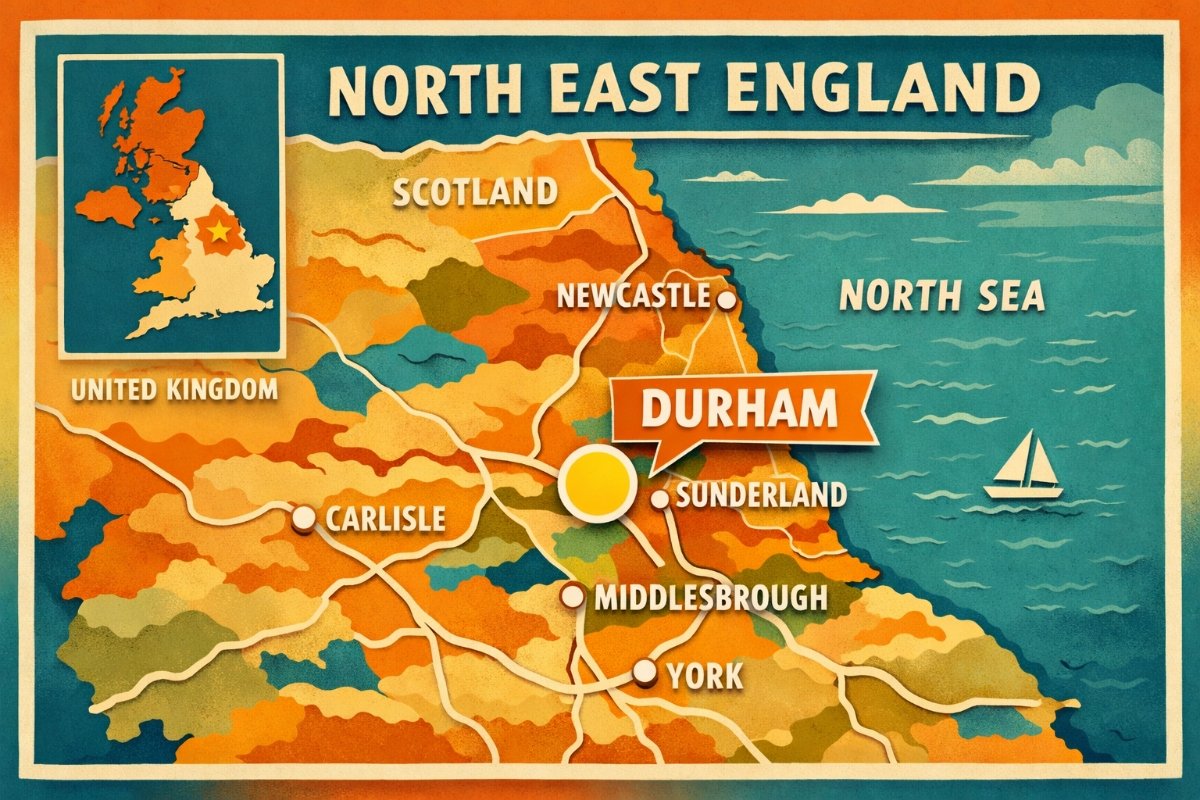
Durham city is located in the North East of England, sitting on the River Wear in a dramatic loop that gives the city its iconic peninsula landscape. It lies approximately 20 miles south of Newcastle upon Tyne and around 14 miles southwest of Sunderland. The city is well connected by road via the A1(M) motorway and by rail on the East Coast Main Line, making it easily accessible from London (around three hours by train), Edinburgh, and York.
Despite its compact size, Durham punches well above its weight in terms of cultural significance. The city centre is dominated by its medieval cathedral and castle, both perched on a wooded hilltop above the river. If you look at a map of England, Durham sits roughly halfway between York and Edinburgh, making it a natural stopping point for travellers exploring the north.
The city falls within the ceremonial county of County Durham and is served by Durham County Council for most local government functions. Its postcode area is DH1, and its nearest major airport is Newcastle International Airport, located roughly 25 minutes away by car.
Where Is County Durham in England
County Durham is a large ceremonial and administrative county in North East England. It stretches from the Pennine hills in the west to the North Sea coastline in the east, bordered by Northumberland to the north, Tyne and Wear to the northeast, Cumbria to the west, and North Yorkshire and Darlington to the south.
It is important to understand the distinction between the administrative county and the ceremonial county. The administrative county of County Durham is governed by Durham County Council and covers a wide area including towns such as Bishop Auckland, Consett, Chester-le-Street, and Newton Aycliffe. The ceremonial county is slightly larger and includes the Borough of Darlington, which operates as a separate unitary authority but falls within County Durham for ceremonial and geographical purposes.
County Durham covers approximately 862 square miles, making it one of the larger counties in England. The landscape is remarkably varied, ranging from the wild moorlands of the North Pennines Area of Outstanding Natural Beauty in the west to gentle lowlands and former coalfield communities in the east.
Is Durham a City or a County
This is one of the most commonly searched questions about Durham, and the answer is: it is both. Durham city is a small cathedral city with a population of around 50,000 people. County Durham is the much larger county that surrounds and includes the city. Think of it the same way you might think of York (a city) sitting within North Yorkshire (a county).
Durham was granted city status centuries ago due to the presence of its cathedral. It is one of the smallest cities in England by population, but its historical and cultural importance far exceeds its size. When people refer to “Durham” without further context, they usually mean the city. When discussing local government, geography, or regional identity, the term “County Durham” is used to refer to the wider area.
What County Is Sunderland In
A common point of confusion is whether Sunderland falls within County Durham. It does not. Sunderland is located in the metropolitan county of Tyne and Wear, which also includes Newcastle upon Tyne, Gateshead, South Tyneside, and North Tyneside. Tyne and Wear was created in 1974 as part of local government reorganisation, and it drew some areas that were historically part of County Durham into the new metropolitan county.

So while Sunderland sits close to the County Durham border and shares some historical ties, it is administratively and ceremonially a separate entity within Tyne and Wear. If you are searching for information about Sunderland, it is best to look under Tyne and Wear rather than County Durham.
Why Durham Is Famous
Durham’s fame rests on a combination of extraordinary history, stunning architecture, and a university that consistently ranks among the best in the world. Few cities of this size can claim a UNESCO World Heritage Site, a Norman castle, and a top-five UK university all within a few minutes’ walk of each other.
Historical Importance of Durham
Durham’s history stretches back over a thousand years. The city’s origins are closely tied to the story of St Cuthbert, the revered Northumbrian saint whose remains were brought to the Durham peninsula by monks fleeing Viking raids in 995 AD. The community that grew up around the shrine of St Cuthbert became one of the most powerful religious centres in medieval England.
After the Norman Conquest of 1066, William the Conqueror recognised Durham’s strategic importance and ordered the construction of Durham Castle to defend against threats from the north. The Prince Bishops of Durham wielded extraordinary power for centuries, governing the region as a palatinate with the authority to raise armies, mint coins, and administer justice independently of the Crown. This unique arrangement lasted until 1836 and gave Durham a political significance that few English cities outside London could match.
The city also played an important role during the English Civil War and the industrial revolution, when County Durham became one of the great coalfield regions of Britain. Today, Durham’s history is preserved in its architecture, its traditions, and the stories told within its cathedral walls.
Key Landmarks in Durham
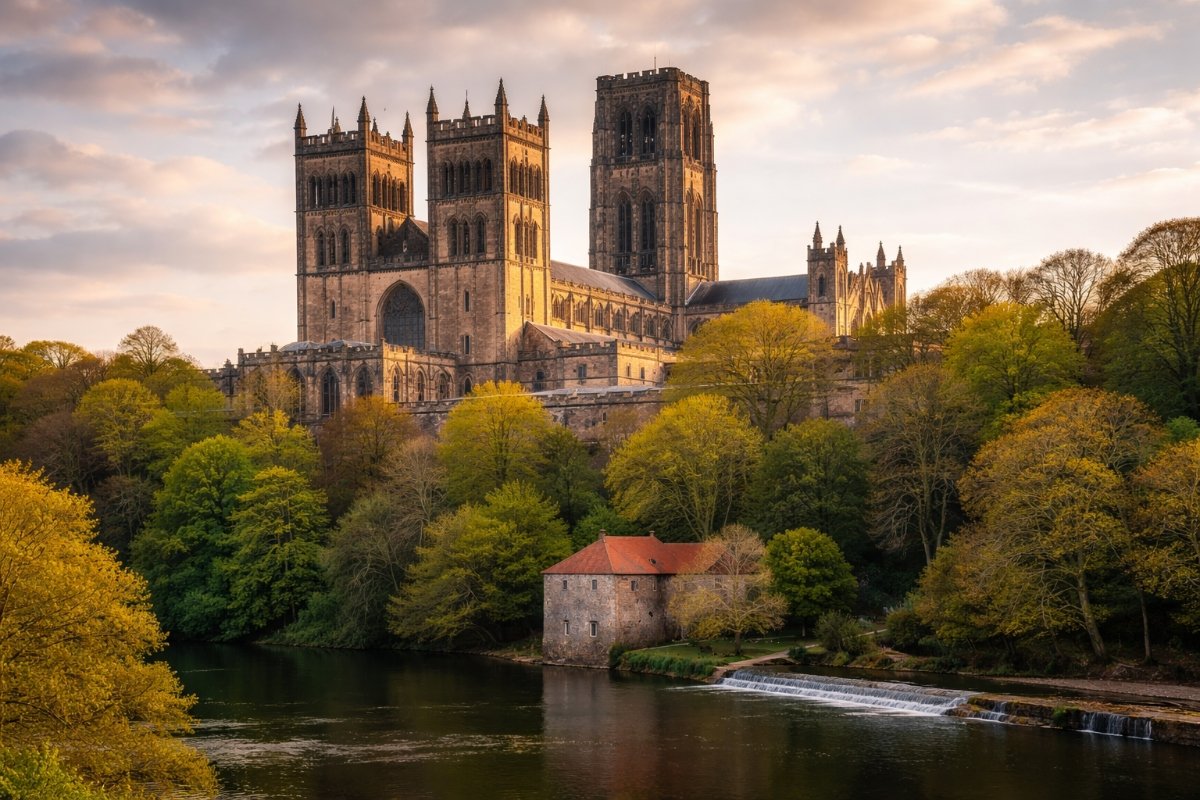
Durham Cathedral is widely regarded as one of the finest examples of Norman architecture in Europe. Completed in 1133, it houses the tombs of St Cuthbert and the Venerable Bede, two of the most important figures in early English Christianity. The cathedral was designated a UNESCO World Heritage Site in 1986 alongside Durham Castle, and it regularly features in polls as one of the most loved buildings in Britain.
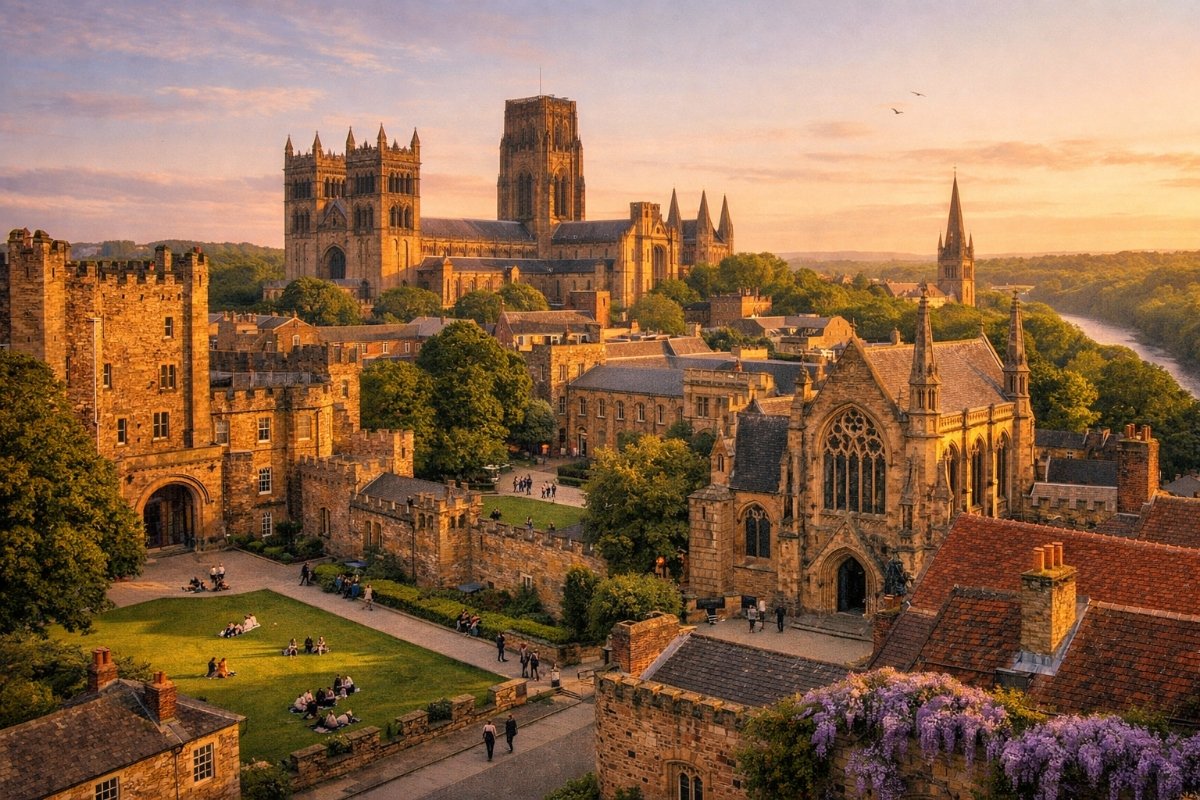
Durham Castle stands directly opposite the cathedral on the peninsula and has served as the home of University College, Durham, since 1837. It is one of the largest Norman castles in England and offers guided tours that take visitors through its medieval great hall, chapel, and keep.
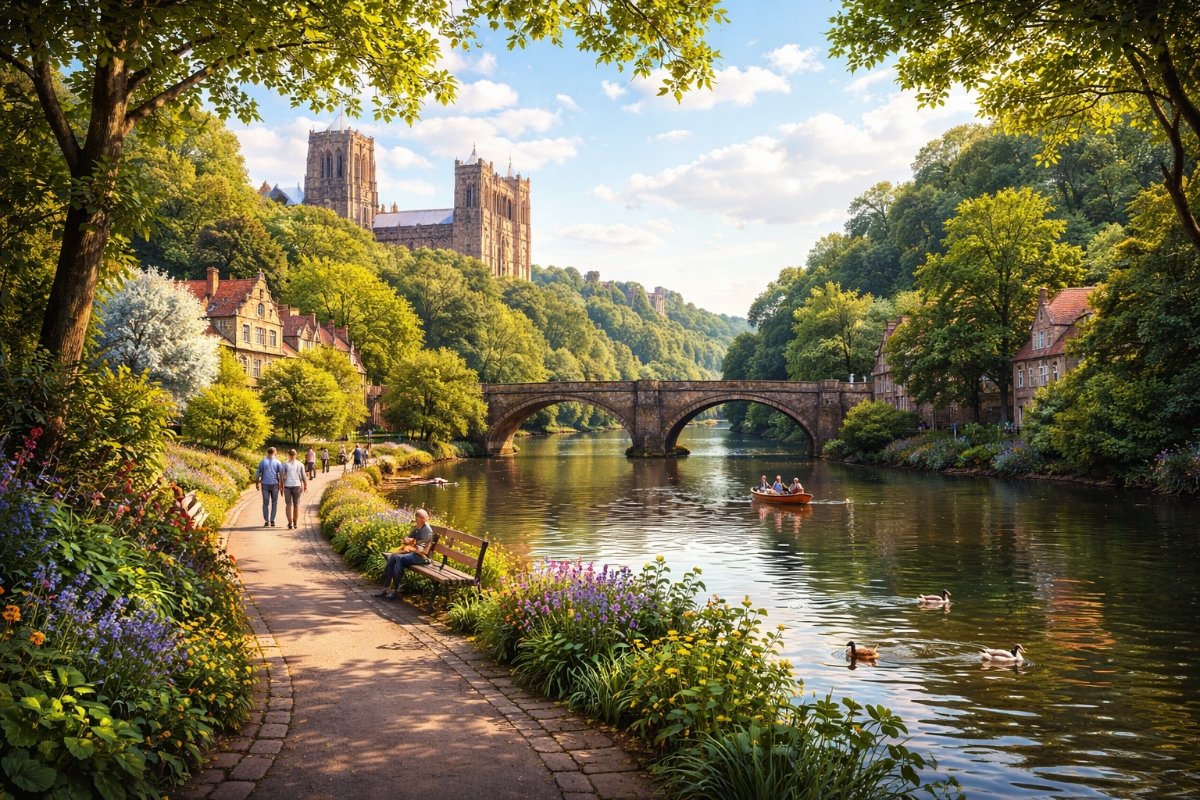
The River Wear curves around the city centre in a tight loop, creating the wooded gorge that gives Durham its distinctive silhouette. The riverbanks are a popular spot for walking, rowing, and photography, and the views from Prebends Bridge and Framwellgate Bridge are among the most photographed in the North of England.
Things to Do in Durham
Durham may be small, but it offers a surprising range of activities for visitors of all ages. From world-class heritage sites to peaceful riverside walks and vibrant local markets, there is plenty to fill a day trip or a longer stay.
Top Attractions in Durham
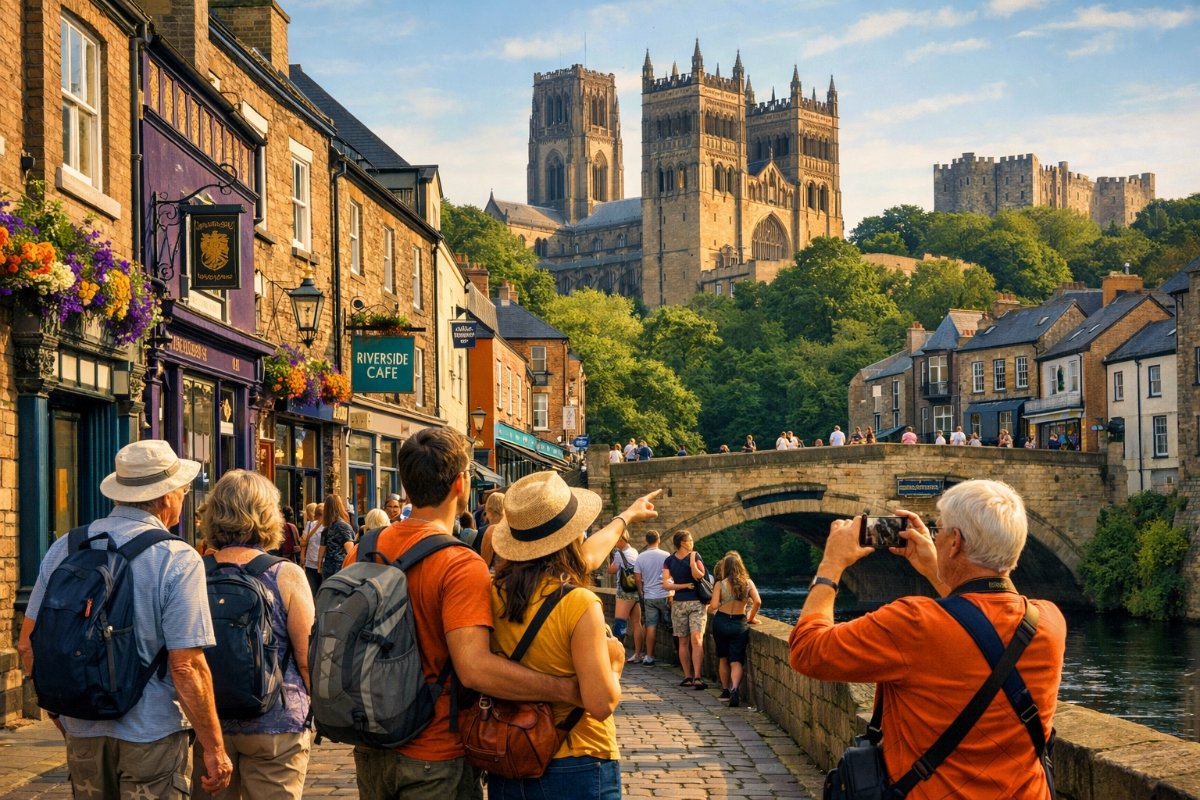
The obvious starting point is Durham Cathedral, which is free to enter (donations welcome) and offers tower climbs with panoramic views across the city and surrounding countryside. Inside, the cathedral houses the treasures of St Cuthbert, medieval manuscripts, and one of the finest collections of Romanesque carved stonework in Europe.
Durham Castle is accessible via guided tours and provides a fascinating insight into nearly a thousand years of continuous use, from Norman fortress to princely palace to university college. The castle’s Norman Chapel, dating from around 1078, is one of the oldest surviving examples of Norman religious architecture in England.
The riverside walk along the River Wear is one of the most enjoyable free activities in the city. The circular path takes you through ancient woodland, past old mills, and under the dramatic silhouette of the cathedral and castle perched on the cliff above. During summer, you can hire rowing boats from the boathouse near Elvet Bridge.
Other notable attractions include the Oriental Museum (one of the few museums in the UK dedicated entirely to art and archaeology from Asia and the Middle East), the Durham Museum and Heritage Centre, and Crook Hall and Gardens, a beautifully preserved medieval hall with walled gardens.
Best Activities for Visitors
Walking tours are one of the best ways to explore Durham. Several operators offer guided walks covering the city’s history, ghost stories, and hidden lanes. Self-guided walking routes are also available from the tourist information centre near the Market Place.
Durham’s indoor market and the regular open-air markets in the Market Place offer local produce, crafts, street food, and vintage goods. The market square itself is one of the finest medieval market places in England, surrounded by historic buildings and independent shops.
If you enjoy the outdoors, rowing on the River Wear is a quintessential Durham experience. The river is also popular for kayaking and canoeing. For longer walks, the Railway Paths network offers traffic-free cycling and walking routes that follow the tracks of old colliery railways through the Durham countryside.
Durham is also home to a lively programme of festivals and events throughout the year, including the Durham Book Festival, Lumiere (a biennial light festival that transforms the city centre into an open-air gallery), and the Durham Miners’ Gala, one of the largest trade union gatherings in Europe.
Best Time to Visit Durham
Spring (April to May) is an excellent time to visit, as the riverside woodlands come alive with bluebells and the weather is generally mild. The city is less crowded than during the summer months, and you can enjoy the cathedral and castle without long queues.
Summer (June to August) brings the warmest weather and the longest days, making it ideal for outdoor activities such as rowing, walking, and exploring the countryside. This is also peak tourist season, so accommodation should be booked well in advance.
Autumn (September to October) offers beautiful foliage along the river gorge and a quieter atmosphere as the university term begins. The Durham Book Festival typically takes place in October and adds a cultural dimension to any autumn visit.
Winter (November to February) can be cold, but Durham has a magical quality in winter, particularly during the Christmas period when the cathedral hosts carol services and the Market Place features festive stalls. The Lumiere festival, when it runs, takes place in November and is a spectacular reason to visit after dark.
What to See in Durham (Must-Visit Places)
Beyond the headline attractions, Durham is packed with lesser-known gems that reward the curious visitor. From quiet medieval churches to sweeping natural landscapes, there is more to see here than most first-time visitors expect.
Cultural and Historical Sites
St Oswald’s Church, located near the cathedral, dates back to the 12th century and is one of Durham’s hidden treasures. It offers a peaceful contrast to the grandeur of the cathedral and provides an intimate glimpse into medieval parish life.
The Durham Heritage Centre and Museum, housed in the former Church of St Mary-le-Bow, tells the story of the city from its origins to the present day through artefacts, photographs, and interactive displays. It is a small but well-curated museum that is often overlooked by visitors focused on the cathedral.
Palace Green Library, part of Durham University, hosts regular exhibitions drawn from the university’s outstanding special collections, including medieval manuscripts, rare books, and archives. The building itself is a beautiful example of Georgian architecture set on the green between the cathedral and the castle.
For those interested in industrial and social history, Beamish Museum is located just a few miles north of Durham city. This open-air living museum recreates life in the North East during the 1820s, 1900s, and 1940s, with working farms, shops, a tramway, and costumed interpreters. It is one of the most popular heritage attractions in the region and easily accessible from Durham by bus or car.
Natural Attractions
The River Wear gorge that encircles the city centre is itself a natural attraction. The steep, wooded banks are home to a variety of wildlife, including kingfishers, herons, and otters. The walking path along the river provides constantly changing views of the cathedral and castle from below.
Botanic Garden, maintained by Durham University, covers 10 hectares on the southern edge of the city and features collections of plants from around the world, including a tropical rainforest house, a cactus house, and a bamboo grove. It is a peaceful retreat just a short walk from the city centre.
Further afield, the North Pennines Area of Outstanding Natural Beauty begins in western County Durham and offers some of the most dramatic upland scenery in England. Highlights include High Force waterfall (one of the tallest in England), the Weardale Valley, and Hamsterley Forest, which provides trails for walking, cycling, and horse riding.
The Durham Heritage Coast on the eastern edge of the county has been transformed from former colliery land into a beautiful stretch of coastline with cliffs, rock pools, wildflower meadows, and sweeping sea views. It is an unexpected gem that many visitors to the region overlook entirely.
About County Durham
County Durham is far more than just the area around Durham city. It is a large, diverse county with a rich industrial heritage, stunning natural landscapes, and a network of market towns and villages that each have their own character and story to tell.
Geography and Location Overview
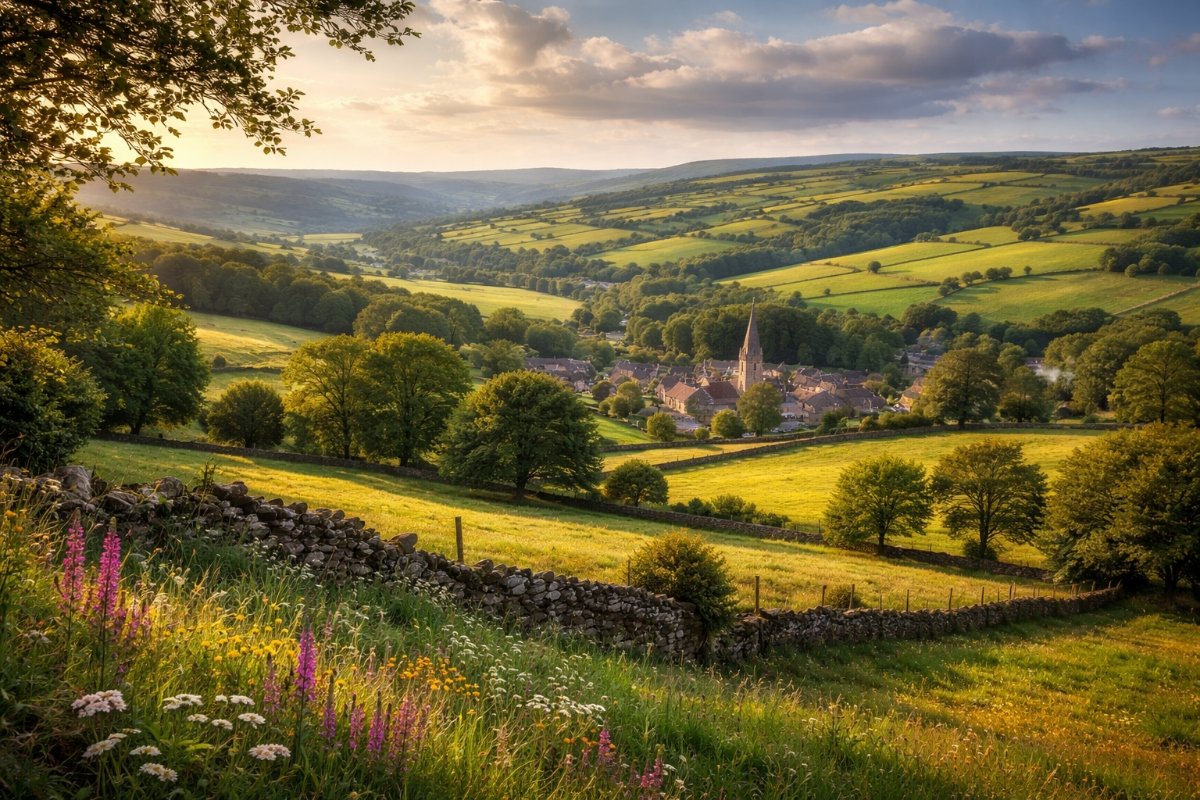
County Durham occupies a central position in the North East of England. Its western boundary follows the Pennine ridge, while to the east it reaches (in its ceremonial form) close to the North Sea coast. The county is crossed by several major river valleys, most notably the Wear, the Tees, and the Derwent, which have shaped both the landscape and the pattern of settlement over centuries.
The terrain ranges from upland moorland above 600 metres in the Pennines to gentle lowland plains in the east. This variety of landscape supports diverse farming, forestry, and tourism activities. The county’s road network is centred on the A1(M) motorway, which runs north-south through the eastern part of the county, and the A66, which crosses east-west connecting Teesside with the Lake District.
Major Towns and Cities in County Durham
Durham city is the county town and the administrative centre. It is home to the county council offices, the cathedral, the castle, and the university.
Bishop Auckland is a market town in the south of the county that has undergone significant regeneration in recent years. It is home to Auckland Castle (the historic residence of the Prince Bishops of Durham), the Kynren outdoor live-action show, and The Auckland Project, a major arts and heritage initiative that has brought new galleries, gardens, and visitor attractions to the town.
Chester-le-Street sits on the northern edge of the county and is known for its cricket ground (the Seat Unique Riverside, home of Durham County Cricket Club) and its connections to the story of St Cuthbert, whose coffin rested here for over a century before being moved to Durham.
Other notable towns include Consett (a former steelmaking town on the western hills), Newton Aycliffe (a post-war new town with a growing business park), Barnard Castle (a picturesque market town in Teesdale known for the Bowes Museum), and Seaham (a coastal town with dramatic clifftop walks and connections to the poet Lord Byron).
Relationship Between Durham and Nearby Cities
Durham’s proximity to other major cities in North East England is one of its great advantages. Newcastle upon Tyne is just 15 miles to the north and is reachable in around 12 minutes by train. Newcastle offers a larger range of shopping, nightlife, dining, and cultural venues, and many Durham residents commute there for work.
Sunderland lies around 14 miles to the northeast. While it is in a different county (Tyne and Wear), the two are closely linked by road and shared regional identity. Sunderland offers a seafront, the National Glass Centre, and the Stadium of Light.
To the south, Darlington is approximately 20 miles away and provides additional rail connections, including services on the East Coast Main Line and the Tees Valley line. Beyond that, Middlesbrough and the wider Tees Valley area are within easy reach, offering further employment, leisure, and cultural opportunities.
Durham, Newcastle and Sunderland at a Glance
| Feature | Durham | Newcastle upon Tyne | Sunderland |
|---|---|---|---|
| County | County Durham | Tyne and Wear | Tyne and Wear |
| Population (approx.) | 50,000 | 300,000 | 175,000 |
| University | Durham University (Russell Group) | Newcastle Uni, Northumbria Uni | University of Sunderland |
| UNESCO World Heritage Site | Yes (Cathedral and Castle) | Hadrian’s Wall (nearby) | No |
| Train to London | Approx. 3 hours | Approx. 3 hours | Approx. 3.5 hours (via Durham/Newcastle) |
| Known For | Cathedral, castle, university | Nightlife, culture, shopping | Glass heritage, coastline, football |
Durham University Guide
Durham University is one of the oldest and most respected universities in England. It is a major reason why thousands of people search for information about Durham each year, and it plays a central role in the life and economy of the city.
Overview of Durham University
Durham University was founded in 1832, making it the third-oldest university in England after Oxford and Cambridge. Like those two institutions, Durham operates a collegiate system, with students belonging to one of 17 colleges that provide accommodation, social life, and pastoral support alongside the academic departments.
The university occupies two main sites: the historic city-centre campus (including the castle, the cathedral close, and the Science Site on the edge of the peninsula) and the larger Queen’s Campus development at Stockton-on-Tees, although most activity is now concentrated on the Durham campus. The university is a member of the prestigious Russell Group of research-intensive UK universities.
Is Durham University Good
By almost every measure, yes. Durham University consistently ranks among the top universities in the UK and the world. It typically appears in the top five or six in major UK league tables (including The Times/Sunday Times Good University Guide, The Guardian University Guide, and the Complete University Guide) and within the top 100 globally in the QS World University Rankings and Times Higher Education rankings.
The university has particular strengths in humanities, social sciences, law, business, geography, earth sciences, and education. Its student satisfaction scores are generally high, and its graduate employment rate is among the best in the UK. Durham is frequently cited as one of the top alternatives to Oxford and Cambridge, and competition for places is intense, particularly in subjects such as law, English, history, and natural sciences.
How Many Students Join Durham University Every Year
Durham University admits approximately 5,000 to 6,000 new undergraduate students each year, alongside a significant intake of postgraduate taught and research students. The total student population is around 20,000, a figure that has a significant impact on the life and economy of a city with a resident population of around 50,000.
Admission is highly competitive. For many popular courses, the typical offer requires A-level grades of A*AA or AAA. International students make up a growing proportion of the student body, drawn by Durham’s academic reputation, its historic setting, and its strong links with employers and graduate schools worldwide.
Popular Courses at Durham University
Durham offers a wide range of undergraduate and postgraduate programmes across its three faculties: Arts and Humanities, Science, and Social Sciences and Health. Some of the most popular and highly regarded courses include:
- Law – consistently ranked among the top law programmes in the UK
- Business and Management – Durham University Business School holds triple accreditation (AACSB, AMBA, EQUIS), a distinction held by fewer than 1% of business schools worldwide
- English Literature – one of the strongest English departments in the country
- History – excellent research profile and teaching quality
- Natural Sciences – a flexible programme allowing students to combine subjects across the sciences
- Geography – consistently ranked among the top geography departments globally
- Physics and Astronomy – strong research links and excellent facilities
- Computer Science – a growing department with increasing demand
The collegiate experience is also a major draw. Each college has its own traditions, social events, and sporting competitions, creating a strong sense of community that many students cite as a defining feature of their time at Durham.
Quick Facts About Durham
Here is a summary of key facts and figures that give a quick snapshot of Durham city and County Durham for anyone considering a visit, a move, or further research.
Population and Demographics
Durham city has a resident population of approximately 50,000 people, which swells considerably during university term time. County Durham as a whole has a population of around 530,000, making it one of the more populous counties in North East England. The population is predominantly white British, though the university brings significant international diversity to the city.
The age profile of the city skews younger than the national average due to the large student population, while the wider county has a more typical age distribution with a slightly older-than-average profile in some former mining communities.
Cost of Living in Durham
Durham is generally more affordable than cities in the south of England and compares favourably even with other northern cities like York or Harrogate. Average house prices in Durham city are moderate by UK standards, though they vary significantly depending on the area. Properties close to the city centre and the university tend to command higher prices, while towns and villages in the wider county offer more affordable options.
Rental costs are influenced by the student market, particularly in areas close to the university. For non-students, rental properties in the surrounding towns and villages often represent better value. Day-to-day living costs, including food, transport, and leisure, are generally in line with or below the national average.
Is Durham a Good Place to Live or Visit
Durham consistently scores well in quality-of-life assessments. Its compact, walkable city centre, low crime rate, excellent schools, strong sense of community, and proximity to both countryside and coast make it an attractive place to live for families, professionals, and retirees alike.
For visitors, Durham offers a rare combination of world-class heritage, natural beauty, and accessibility. You can explore a UNESCO World Heritage Site, walk along a beautiful river gorge, browse independent shops and markets, and enjoy excellent food and drink, all within a city small enough to cover on foot in a single day. It is also an excellent base for exploring the wider North East, including Hadrian’s Wall, the North Pennines, and the Northumberland coast.
Frequently Asked Questions About Durham
Where Is Durham City?
Durham city is located in North East England, approximately 20 miles south of Newcastle upon Tyne. It sits on the River Wear within the county of County Durham and is easily accessible by road (A1(M)) and rail (East Coast Main Line).
Where Is County Durham?
County Durham is a ceremonial and administrative county in North East England. It is bordered by Northumberland to the north, Tyne and Wear to the northeast, North Yorkshire and Darlington to the south, and Cumbria to the west. It stretches from the Pennine hills to near the North Sea coast.
What to Do in Durham?
Top activities include visiting Durham Cathedral and Castle (a UNESCO World Heritage Site), walking along the River Wear, exploring the indoor and outdoor markets, rowing on the river, touring the university’s colleges, and visiting nearby attractions such as Beamish Museum and the North Pennines. Durham also hosts popular annual events including the Lumiere light festival, the Durham Miners’ Gala, and the Durham Book Festival.
What to See in Durham?
Must-see sites include Durham Cathedral, Durham Castle, the River Wear and its bridges (particularly Prebends Bridge and Framwellgate Bridge), Palace Green, the Botanic Garden, the Oriental Museum, and St Oswald’s Church. For day trips, Beamish Museum, Barnard Castle, and the Durham Heritage Coast are all within easy reach.
Is Durham University Worth It?
Durham University is widely considered one of the best universities in the UK. It consistently ranks in the top five or six nationally and within the top 100 globally. Its collegiate system, strong graduate employment record, triple-accredited business school, and historic setting make it a highly attractive choice for students. Competition for places is strong, and the university is frequently regarded as one of the leading alternatives to Oxford and Cambridge.
Visit NEWSAxis for more latest NEWS in UK.