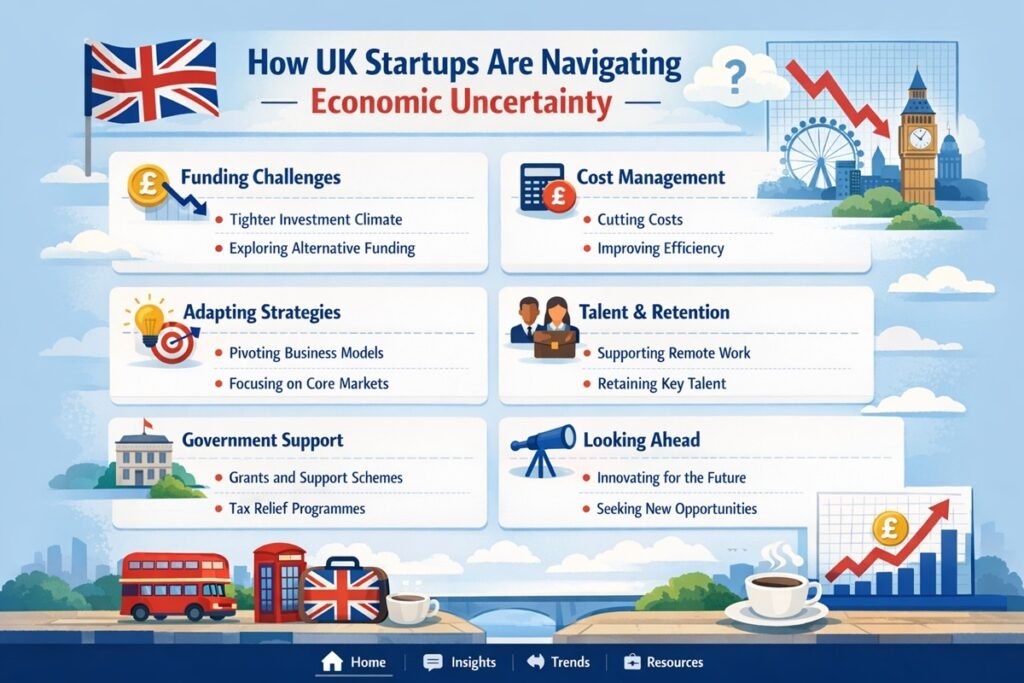

The UK economy has spent much of the past few years in a state of uncomfortable flux. Inflation that ran well above the Bank of England’s 2% target, interest rates climbing to their highest levels in over a decade, and a post-pandemic hangover that squeezed both consumer spending and business investment — it has been a turbulent stretch for anyone building a company from the ground up.
Yet for all the headlines about doom and decline, something quietly remarkable has been happening in the UK startup ecosystem. Founders are adapting. Investors are recalibrating. And a new generation of resilient, leaner, more strategically savvy businesses is emerging from the pressure.
This is the story of how UK startups are navigating economic uncertainty — and what it might mean for the country’s entrepreneurial future.
The Economic Backdrop: What UK Startups Are Up Against
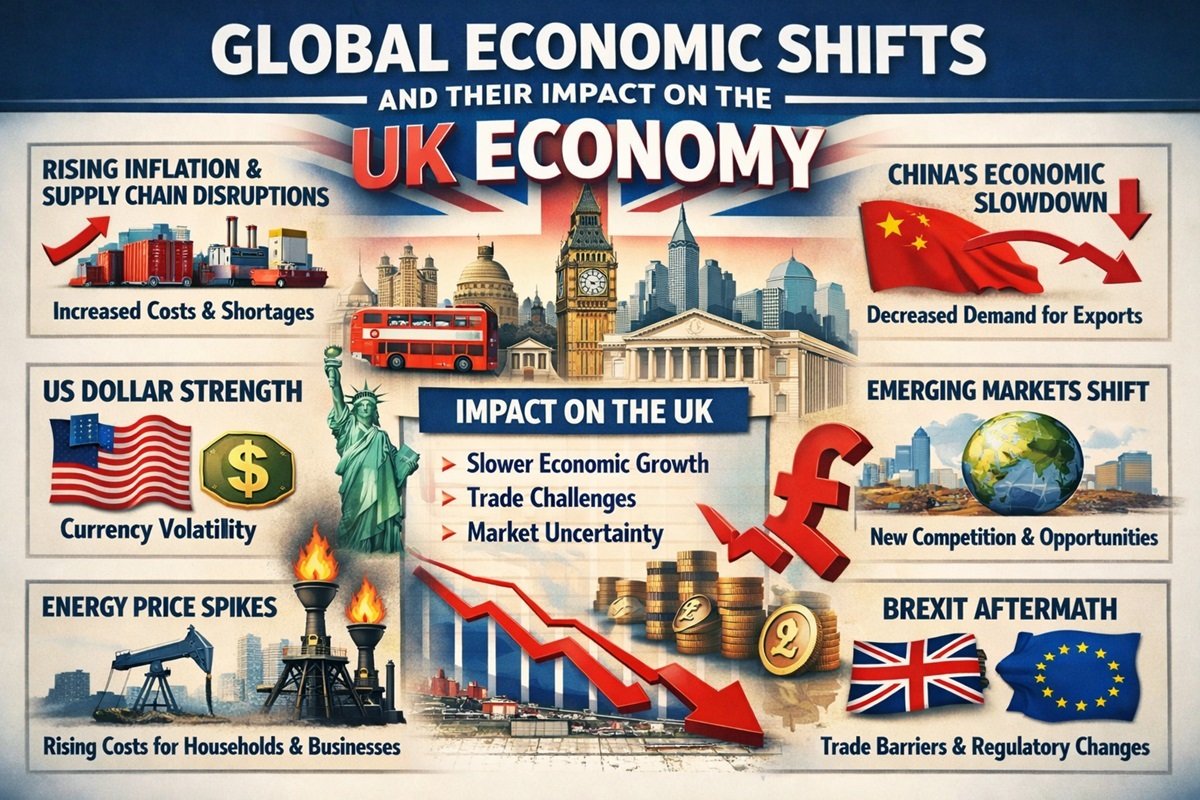
To understand how startups are responding, you first need to appreciate the scale of the challenge they’ve faced. The UK’s economic uncertainty isn’t a single problem — it’s a confluence of pressures hitting from multiple directions simultaneously.
Inflation eroded purchasing power and pushed up operational costs across the board. Energy bills, office space, salaries, and supplier costs all surged. For early-stage businesses operating on tight margins, even a 15–20% increase in overheads can be the difference between surviving and shutting the doors.
Interest rates, which the Bank of England raised aggressively to combat inflation, made borrowing significantly more expensive. For startups that had grown accustomed to cheap debt and easy money, the recalibration was sharp and unforgiving.
Startup funding in the UK also took a notable hit. After the venture capital boom of 2021, when global money flooded into tech and growth companies at record valuations, the tide turned. Investors became more cautious, due diligence cycles lengthened, and valuations were marked down across the board.
Add to this the lingering consequences of Brexit — particularly for businesses reliant on European talent or cross-border trade — and you have an environment that would test even the most battle-hardened founding team.
Key Challenges Facing UK Startups Today
The challenges are well-documented, but it’s worth being specific. The pain points facing UK startups right now are not abstract — they’re operational, financial, and deeply personal for the people building these businesses.
1. The Funding Freeze (and Thaw)
The most discussed challenge in UK startup circles has been the slowdown in venture capital activity. After the exuberance of 2020 and 2021, investors pulled back sharply. Seed rounds became harder to close. Series A timelines stretched. And Series B and beyond? For many companies, those conversations simply stopped.
The shift in venture capital UK sentiment has been both structural and psychological. Rising interest rates meant that the opportunity cost of deploying capital into high-risk, long-horizon startups increased meaningfully. Investors who had previously accepted “growth at all costs” narratives began demanding a credible path to profitability — often within 18 to 24 months.
This was a culture shock for many founders who had built their business models around the assumption of continued cheap capital.
2. Talent Pressures and Hiring Complexity
Finding and retaining top-quality people remains one of the most persistent UK business challenges for startups. The competition for skilled engineers, product managers, and commercial talent is fierce — particularly from larger corporates that can offer more stability and better benefits.
Post-Brexit restrictions on EU talent have added another layer of complexity. Many UK startups that previously recruited freely across Europe now face visa costs, sponsorship obligations, and longer hiring timelines. This has pushed up recruitment costs at exactly the wrong moment.
3. Cost Pressures Across the Business
Inflation’s impact on UK startups has been felt across nearly every cost line. Key areas of pressure include:
- Office and workspace costs — rising rents in major cities, particularly London, have forced many startups to renegotiate leases or abandon physical offices entirely
- Energy bills — particularly acute for hardware, manufacturing, and foodtech startups
- Payroll and National Insurance — increases to employer contributions have added meaningfully to headcount costs
- SaaS and software tools — many US-based tools repriced in dollar terms, hitting UK startups with a double whammy of price rises and currency headwinds
4. Customer Caution and Longer Sales Cycles
For B2B startups, one of the most frustrating consequences of UK economic uncertainty has been the lengthening of enterprise sales cycles. Procurement teams facing their own budget pressures have become more conservative, deals require more sign-offs, and pilots that might once have converted quickly are stalling at the proof-of-concept stage.
For consumer-facing businesses, the squeeze on household budgets has been equally challenging. Discretionary spending contracted, churn rates increased, and convincing cash-strapped customers to try a new product became an uphill battle.
How UK Startups Are Adapting: Survival Strategies That Actually Work
Here’s where the story gets interesting — and, frankly, encouraging. The pressure of the past few years has forced a degree of operational discipline and creative thinking that many in the UK startup ecosystem believe will produce a healthier, more durable cohort of businesses.
Leaning Into Lean: Cost Discipline as a Competitive Advantage
The shift from “growth at all costs” to “efficient growth” has been one of the defining pivots of the past two years. Startups that previously judged themselves on monthly revenue growth or user acquisition numbers are now tracking burn multiples, gross margins, and payback periods with the same intensity.
Some of the most common startup survival strategies in the UK have involved hard decisions about headcount. Layoffs that felt unthinkable in 2021 became necessary and — when handled transparently — a route to extending runway and buying time to prove the core business model.
But the smartest operators haven’t just cut indiscriminately. They’ve made surgical reductions — exiting non-core product lines, consolidating teams, and doubling down on the use cases or customer segments with the strongest unit economics.
AI Adoption: Doing More With Less
If there’s one trend that has genuinely transformed the operational calculus for UK startups in the face of economic pressure, it’s the rapid adoption of artificial intelligence tools across every function of the business.
Engineering teams are using AI coding assistants to accelerate development without adding headcount. Marketing teams are using generative AI to produce content, run campaigns, and personalise customer communications at scale. Customer success functions are being partly automated using AI-powered chatbots and self-serve resources.
For founders grappling with rising costs and a reluctance to hire, AI adoption has become a genuine lever for maintaining productivity and even expanding capability. A startup that might have needed a team of 20 to deliver a certain output two years ago can increasingly achieve the same with a team of 12 — if they’re using the right tools intelligently.
Strategic Pivots and Market Repositioning
Some of the most compelling examples of UK startup resilience involve deliberate, strategic pivots in response to changing market conditions. Rather than persisting with a model that was no longer working, founders are showing a willingness to fundamentally reexamine their assumptions.
A fintech originally built around buy-now-pay-later products — a category that fell out of favour as consumer debt concerns mounted — might pivot to offer financial wellness tools targeting the same demographic from a different angle. A proptech startup targeting first-time buyers might shift its focus to the rental market as homeownership becomes increasingly inaccessible.
These pivots aren’t panic. They’re pragmatism — and the founders who execute them well tend to emerge with sharper product thinking, clearer customer understanding, and a business model better suited to the actual market they’re operating in.
Remote and Distributed Teams: The Talent Geography Shift
One of the most practical responses to both talent pressures and cost constraints has been a more deliberate embrace of remote and geographically distributed teams. UK startups are increasingly hiring top engineers and commercial talent from across Europe and beyond — building product teams in lower-cost locations while maintaining UK-based leadership and go-to-market functions.
This model isn’t without complexity — time zones, culture, and communication require active management — but for startups willing to invest in the infrastructure of remote work, it offers a meaningful way to access world-class talent without the premium price tag of a London-based hire.
Revenue Diversification and Hybrid Models
Startups that relied on a single revenue stream or a narrow customer segment have learned, often painfully, the risks of concentration. The response has been a move toward diversification — adding complementary products, targeting new verticals, or layering services revenue on top of software subscriptions.
Many B2B SaaS startups, for example, have introduced professional services offerings — implementation, consulting, custom development — to accelerate revenue in the short term while their recurring subscription base continues to build. This hybrid model sacrifices some margin elegance but provides critical cash flow stability.
The Shifting Role of Investors and Venture Capital in the UK
The relationship between UK startups and their investors has undergone a fundamental reset. The days of term sheets being signed on the back of a compelling deck and a charismatic founder pitch are, for now, firmly behind us.
Today’s venture capital UK landscape is characterised by:
- Longer diligence processes — investors are spending more time validating commercial traction, speaking to customers, and scrutinising financial models
- Smaller initial cheques — many VCs are writing smaller initial investments and reserving follow-on capital for companies that demonstrate clear milestones
- A focus on capital efficiency — investors are asking hard questions about burn rate, runway, and the ratio of capital consumed to revenue generated
- Sector preference shifts — areas like climate tech, defence tech, healthtech, and AI infrastructure are attracting disproportionate attention, while consumer apps and pure-play marketplaces have fallen out of favour
There are also structural changes underway. Corporate venture arms of major UK companies — from financial institutions to energy giants — have become more active investors, bringing not just capital but strategic value and distribution opportunities. Meanwhile, angel networks and syndicates have filled some of the gap left by institutional investors pulling back from early-stage rounds.
For startup funding in the UK, the picture is not as bleak as the headlines sometimes suggest. Capital is still available — it’s just more selective. The founders who are raising successfully are those who have done the work: they understand their unit economics, they can articulate a credible path to profitability, and they’ve built something with demonstrable market pull.
Government Support, Policy, and the Startup Ecosystem
The UK government has long positioned itself as a champion of entrepreneurship, and there are genuine support mechanisms in place — though founders sometimes find navigating them frustratingly complex.
EIS and SEIS: A Critical Tax Incentive Framework
The Enterprise Investment Scheme (EIS) and Seed Enterprise Investment Scheme (SEIS) remain among the most powerful tools available to early-stage UK startups seeking investment. By offering meaningful tax reliefs to investors — including income tax relief and capital gains exemptions — these schemes have helped channel private capital into high-risk early-stage companies that might otherwise struggle to attract funding.
Recent reforms have expanded the limits of SEIS in particular, allowing companies to raise more at the seed stage under the scheme. For many pre-revenue or early-revenue startups, SEIS-qualifying fundraises remain the most practical route to initial capital.
Innovate UK and R&D Grants
Innovate UK, the government’s innovation agency, continues to distribute grants and loans to technology-led startups across a range of sectors. For hardware, deep tech, and science-based startups, these grants can be transformational — providing non-dilutive capital at precisely the stage where equity financing is most expensive.
The R&D tax credit scheme, despite a series of reforms that reduced its generosity for SMEs, remains a meaningful source of cash for startups investing heavily in product development. Founders who work with specialist R&D tax advisors are often surprised by how much they can claim back.
The British Business Bank
The British Business Bank has been an important backstop for UK startup financing, deploying capital through its own programmes and catalysing private investment through co-investment funds and guarantees. Its Future Fund — launched during the pandemic — set a precedent for government intervention in startup financing that some argue should be expanded.
Stories of Resilience: How UK Startups Are Actually Doing It
Beyond strategy frameworks and policy discussions, the most instructive lessons come from the ground level — the decisions founders are actually making to keep their companies alive and growing.
Consider the profile of a UK climate tech startup that, facing a frozen fundraising market, chose to focus obsessively on a single enterprise customer segment and delivered a series of high-value pilot projects before seeking its next funding round. Rather than burning cash on premature growth, the team spent 12 months building an irrefutable case study — and raised a substantially oversubscribed round when the time came.
Or a B2B software business that saw its enterprise pipeline dry up as procurement budgets tightened, and responded by launching a self-serve product tier targeted at SMEs — a segment it had previously ignored. Within six months, this new revenue stream was contributing meaningfully to ARR and providing a buffer against the slower-moving enterprise deals.
Then there’s the ecommerce brand that, facing rising customer acquisition costs and declining return on ad spend, pivoted its marketing strategy entirely towards community-building and organic content. By investing in genuine relationships with its customer base rather than paid channels, it reduced its CAC substantially and improved retention metrics — a counter-intuitive but ultimately more resilient growth engine.
What these examples share is a common thread: founders who were willing to challenge their own assumptions, make uncomfortable decisions quickly, and focus relentlessly on demonstrating real value to real customers.
The Future Outlook: Challenges Remain, But Opportunity Is Real
The economic outlook for UK startups entering the next phase is genuinely mixed — but not pessimistic. The conditions that made the past few years so difficult are, in many respects, beginning to stabilise. Inflation has moderated. Interest rates have started to come down. And investor appetite, while more selective than in the boom years, is showing signs of recovery.
More importantly, the underlying fundamentals that make the UK a compelling place to build a startup remain strong:
- World-class universities producing deep technical and scientific talent
- A mature and sophisticated financial services ecosystem that provides both capital and potential customers for fintech innovation
- Strong regulatory frameworks that, while sometimes a constraint, also provide a quality signal and market access advantage
- A vibrant and globally connected startup community centred on London but extending to Edinburgh, Manchester, Bristol, Cambridge, and Oxford
- Growing government ambition around AI, clean energy, and life sciences that is beginning to translate into meaningful procurement and policy support
The sectors most likely to generate the next wave of significant UK startups are those at the intersection of deep technology and urgent societal need — climate transition, healthcare AI, defence and cybersecurity, financial infrastructure, and advanced manufacturing. These aren’t short-term trends; they’re decade-long structural shifts that will generate sustained demand for innovative solutions.
Conclusion: The Uncertainty Is the Opportunity
It might sound counterintuitive, but the economic turbulence of the past several years has done something quietly important for the UK startup ecosystem: it has separated those who were building real businesses from those who were simply riding a tide of cheap money and easy optimism.
The startups that have survived — and in many cases thrived — through this period of UK startup economic uncertainty are leaner, more capital-efficient, and more customer-focused than their pre-2022 counterparts. They understand their unit economics. They’ve stress-tested their assumptions. They’ve built teams that can execute under pressure.
That’s not a silver lining. That’s a competitive advantage.
For founders currently in the thick of it — navigating a difficult fundraise, managing rising costs, or trying to close an enterprise deal that keeps slipping — the most honest message is this: the founders who make it through periods like this tend to build the most enduring companies. Not because difficulty is virtuous in itself, but because it forces a clarity of purpose, a precision of execution, and a depth of customer understanding that good times rarely demand.
The UK’s entrepreneurial spirit remains one of its most underappreciated economic assets. And if history is any guide, the companies being built today — forged in the pressure of genuine uncertainty — will be the ones defining British business a decade from now.
The uncertainty, for all its discomfort, is also an invitation. The founders who accept it will shape what comes next.