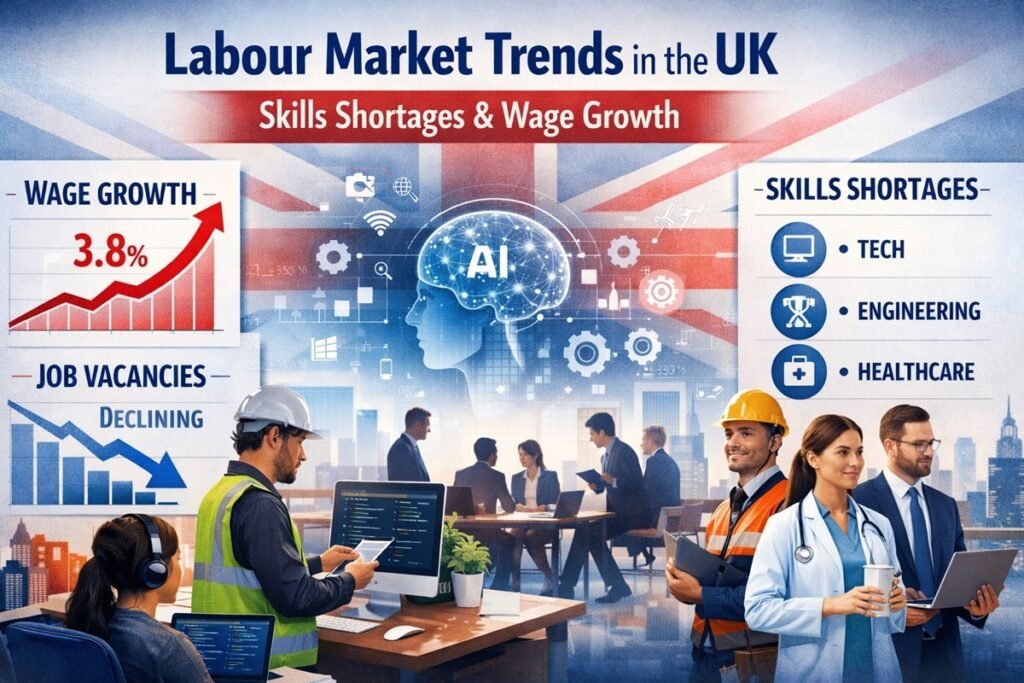

The UK labour market has rarely been more consequential or more complex. Skills shortages are reshaping hiring strategies across entire industries, wage growth is outpacing historical norms, and the relationship between employer demand and worker supply is being fundamentally renegotiated. What was once a background issue for HR departments has become a front-page economic concern.
For business owners trying to hire, for workers navigating a shifting job market, and for policymakers attempting to build a productive and sustainable workforce, the current UK labour market trends demand careful attention. The decisions being made now, about training, immigration, automation, and pay, will shape the UK economy for a generation.
This article provides a comprehensive and grounded analysis of where the UK job market stands today, what is driving the pressures, and what employers, workers, and policymakers can do to navigate the road ahead.
Overview of Current UK Labour Market Trends
The UK labour market entered the mid-2020s in a state of structural tension. Employment levels remained relatively high by historical standards, yet vacancies in key sectors were running at levels that signalled a serious and sustained mismatch between the skills employers need and the workers available to fill those roles.
The post-pandemic recovery period reshuffled the workforce in ways that are still working themselves out. Large numbers of workers exited the labour market entirely during and after the pandemic, through early retirement, long-term sickness, or a reassessment of their working priorities. Many have not returned. This reduction in the overall labour supply created an immediate tightening of the market that employers across most sectors felt acutely.
The result has been a labour market that is simultaneously tight and fragile. Tight in the sense that employers are competing hard for a limited pool of available workers. Fragile in the sense that the underlying structural issues, from skills gaps to inactivity rates, have not been resolved and continue to constrain the UK economy’s productive potential.
Alongside this, UK employment trends have been shaped by a growing emphasis on flexibility. The rise of hybrid and remote working, the expansion of gig economy roles, and the increasing demand for part-time and portfolio working arrangements have all changed the nature of what employment looks like for a significant and growing segment of the workforce.
What Is Driving Skills Shortages in the UK
The UK skills shortage is not a single problem with a single cause. It is the product of several overlapping structural trends that have been building for years and have now reached a point of acute visible pressure.
The Post-Brexit Talent Pipeline Disruption
Before Brexit, the UK had access to a vast and fluid pool of European labour. Workers from across the EU could move to the UK freely, filling roles in hospitality, construction, agriculture, healthcare, and logistics with relatively little friction. This flow of workers suppressed wage growth in some sectors and allowed employers to fill vacancies quickly without investing heavily in domestic recruitment or training pipelines.
The end of free movement changed this fundamentally. Many EU workers already in the UK returned home during the pandemic and did not come back. New arrivals from the EU now require visa sponsorship, which carries costs and administrative burdens that many smaller employers find prohibitive. The result has been a sharp reduction in the available labour supply in several sectors that were heavily reliant on European workers.
The Demographic Challenge
The UK, like most developed economies, faces a significant demographic challenge. An ageing population means that a growing share of the workforce is approaching retirement age, and the cohorts entering the workforce are not large enough to fully replace them. In specialist and experienced roles, particularly in engineering, healthcare, and skilled trades, this demographic cliff edge is creating a talent vacuum that takes years to fill through training and development.
Long-Term Inactivity and Health-Related Exits
One of the most concerning UK workforce shortage trends has been the rise in economic inactivity due to long-term health conditions. The number of working-age people who are neither employed nor actively seeking work due to illness or disability has increased substantially in the post-pandemic period. Mental health conditions, musculoskeletal problems, and the long-term effects of Covid-19 have all contributed to this trend.
This represents both a human cost and a significant economic constraint. Addressing workforce inactivity is one of the most complex challenges in UK labour market policy, sitting at the intersection of health, welfare, and employment systems that are not always well-coordinated.
Education and Training Misalignment
A persistent mismatch exists between the qualifications and skills that the education and training system produces and the skills that employers actually need. The UK has historically over-indexed on academic qualifications and under-invested in vocational and technical education. The result is a graduate population that may be overqualified for some roles and a severe shortage of skilled tradespeople, technicians, and specialists in areas like engineering, digital technology, and healthcare.
Key Sectors Facing the Most Acute Shortages
While workforce shortages in the UK are broad-based, certain sectors are experiencing particularly severe pressures that are affecting their ability to deliver services and sustain growth.
Healthcare and Social Care
The NHS and the wider social care sector represent the most publicly visible manifestation of the UK skills shortage. Nursing, medical specialist, and care worker shortages have been a structural problem for years, but the post-Brexit reduction in European care workers and the pandemic’s toll on workforce wellbeing have made the situation significantly more acute.
Waiting lists, delayed discharges, and pressures on GP access are all, in part, workforce problems. Addressing them requires not just better pay and conditions, but a sustained long-term investment in domestic training pipelines alongside a carefully managed international recruitment strategy.
Construction and the Built Environment
The UK has an acute housing crisis that will require a massive increase in construction activity to address. Yet the construction sector faces some of the most severe skills shortages in the economy. Bricklayers, carpenters, electricians, plumbers, and site managers are all in critically short supply. The average age of skilled tradespeople is rising, and the apprenticeship pipeline has not been producing new entrants at anything like the scale required.
The government’s ambitions for housebuilding and infrastructure development will simply not be achievable without a credible plan to address the construction workforce shortage. This is not a background issue. It is a binding constraint on the ability to deliver one of the most politically important economic priorities.
Technology and Digital
The demand for technology skills is growing faster than the supply in virtually every corner of the economy. Software engineers, data scientists, cybersecurity specialists, AI practitioners, and cloud infrastructure experts are among the most sought-after and hardest to hire workers in the UK job market. The gap between demand and supply in digital skills is not narrowing. It is widening, as businesses across all sectors accelerate their digital transformation programmes.
Logistics and Supply Chain
The logistics sector provides a useful case study in how hiring challenges in the UK interact with broader economic consequences. The HGV driver shortage that became headline news during the pandemic was not a new problem. It was a structural shortage that had been building for years, suddenly made visible when supply chains buckled. The sector has partially recovered, but shortages of skilled logistics professionals, warehouse operators, and supply chain managers remain a live constraint.
Wage Growth Trends: What Is Driving Pay Higher
Wage growth in the UK has been one of the defining economic features of recent years. After more than a decade of broadly stagnant real wages following the 2008 financial crisis, pay growth accelerated sharply in the post-pandemic period. Understanding what is driving this acceleration is essential for both employers managing cost pressures and workers assessing their bargaining position.
The Labour Supply Squeeze
The most fundamental driver of wage growth is straightforward supply and demand. When the supply of available workers falls relative to employer demand, competition for talent drives up the price of labour. The confluence of factors that reduced UK labour supply in the post-pandemic period, including reduced EU migration, rising inactivity, and demographic change, created exactly these conditions.
Employers who needed workers had to pay more to attract and retain them. This was not primarily a choice. It was a market mechanism operating under conditions of genuine scarcity.
Inflation and Real Wage Dynamics
The inflationary surge of 2022 and 2023 created intense pressure for nominal wage increases as workers sought to protect their real living standards. The interaction between inflation and wage growth became one of the key economic concerns of the period. Rising wages feeding into rising prices, which in turn feed pressure for further wage rises, is a dynamic that central banks watch closely and that the Bank of England explicitly factored into its rate-setting decisions.
The important distinction is between nominal wage growth and real wage growth. For extended periods, even as headline pay rises looked impressive, real wages were being eroded by inflation running ahead of pay increases. Workers were earning more in cash terms but buying less with it. This distinction matters enormously for understanding worker wellbeing and consumer spending patterns.
National Living Wage Policy
Government policy has played a direct role in driving wage growth at the lower end of the pay distribution. Successive increases to the National Living Wage have set a rising floor under pay for the lowest-paid workers. While this has been broadly positive for low-income households, it has created significant cost pressures for labour-intensive businesses in sectors like retail, hospitality, and social care.
Sectoral Bidding Wars
In the highest-demand skills categories, particularly technology, data, finance, and healthcare, something closer to a bidding war has developed. Employers competing for a small pool of highly sought-after specialists have driven compensation packages significantly higher. Sign-on bonuses, enhanced benefits, remote working flexibility, and accelerated career progression have all become tools in the competition for top talent in these sectors.
The Link Between Skills Shortages and Wage Growth
The relationship between UK skills shortages and wage growth in the UK is direct and well-established in economic theory. When a specific skill is scarce and in high demand, the market price for that skill rises. The more acute the shortage and the harder the skill is to acquire or replicate, the more significant the wage premium becomes.
This dynamic is visible across the UK economy right now. Sectors and roles facing the most acute shortages are, in almost every case, also the sectors and roles with the fastest growing wages. Skilled tradespeople, specialist nurses, software engineers, and data professionals are all commanding significantly higher compensation than they did five years ago.
For businesses, this creates a difficult strategic question. Do you pay the market rate for scarce skills, absorbing the cost impact? Do you invest in training people internally, accepting a longer timeline before the investment pays off? Do you turn to automation and technology to reduce your dependence on hard-to-hire skills? Or do you relocate some activities to regions or countries where the relevant skills are more readily available? All of these are real strategic choices that businesses are actively navigating.
Impact on Businesses: Cost, Productivity, and Strategy
For UK employers, the current labour market environment represents one of the most significant operational challenges in recent memory. The impact breaks down across several dimensions.
- Recruitment costs have risen sharply. Longer time-to-hire, higher agency fees, more expensive job advertising, and the growing need to invest in employer branding have all added to the cost of filling vacancies. Some businesses are spending two to three times what they did five years ago to recruit equivalent roles.
- Productivity is being constrained by unfilled roles. A business operating with persistent vacancies in key positions is, by definition, operating below its potential productive capacity. The aggregate effect across the economy of millions of unfilled positions is a meaningful drag on GDP growth and business output.
- Staff retention has become a strategic priority. When replacement costs are high and alternatives are plentiful, keeping good people is more valuable than ever. Businesses that invest in culture, development, flexibility, and competitive pay are seeing significantly better retention than those that treat talent management as an afterthought.
- Automation investment is being accelerated. Labour scarcity is one of the most powerful drivers of technology adoption. Businesses that cannot hire the people they need are turning to automation, AI, and process redesign to maintain output. This has long-term productivity benefits but requires upfront capital investment and change management capability.
Impact on Workers: Opportunity and Pressure
For workers, the tight UK job market creates both genuine opportunity and significant pressure.
On the opportunity side, workers in high-demand roles have more bargaining power than at almost any point in recent decades. The ability to command higher salaries, negotiate flexible working arrangements, and change employers without the fear of extended unemployment is real and meaningful for those with sought-after skills.
On the pressure side, the rising cost of living has meant that higher nominal wages have not always translated into improved real living standards. Workers in lower-paid sectors have faced a particularly difficult combination of rising living costs and wages that, while growing, have struggled to keep pace. The mental health and wellbeing toll of economic insecurity, multiple job holding, and unstable work arrangements is also a labour market reality that aggregate statistics do not fully capture.
Role of Immigration, Education, and Training Policy
Addressing the UK’s structural skills shortages requires interventions across multiple policy domains simultaneously. No single lever is sufficient on its own.
Immigration Policy
The post-Brexit points-based immigration system was designed to attract high-skilled workers to the UK while reducing overall net migration. In practice, net migration rose significantly in the immediate post-Brexit period, driven partly by humanitarian factors and partly by employer demand for skills that simply were not available domestically.
The government faces a difficult balancing act. Restricting immigration too aggressively exacerbates skills shortages in critical sectors like healthcare and construction. Opening immigration too broadly can face political resistance and may reduce the urgency of investing in domestic training. The skill-specific visa routes that currently exist are a step in the right direction, but the administrative complexity and cost remain barriers for many smaller employers.
Education and Vocational Training
The long-term solution to skills shortages lies in a sustained and strategic investment in education and training that is better aligned with employer needs. This means:
- Expanding and improving apprenticeship programmes across technical, digital, and healthcare disciplines
- Reforming the apprenticeship levy to make it more accessible and flexible for SMEs that currently find the system difficult to navigate
- Investing in further education colleges as the backbone of vocational and technical training for the workforce of the future
- Strengthening careers education so young people have a realistic and aspirational understanding of the full range of career pathways available, not just the university route
- Supporting adult retraining and lifelong learning for workers in industries facing structural decline who need to transition into growing sectors
Risks and Opportunities in the Current Job Market
The current UK labour market environment is characterised by risks that are real and opportunities that are equally genuine, depending on which side of the supply-demand equation you sit on.
Risks
- A wage-price spiral risk that keeps inflation elevated and forces the Bank of England to maintain higher interest rates for longer, weighing on growth and investment
- Automation-driven displacement for workers in roles that AI and technology can perform more cheaply, particularly in administrative, data processing, and routine service functions
- Geographic inequality as labour market tightness and wage growth are concentrated in London and major cities, while skills shortages in public services like healthcare and education are acutely felt in smaller towns and rural areas
- A two-tier workforce emerging between highly skilled, well-paid workers with strong bargaining power and low-skilled, low-paid workers with limited options and rising living costs
Opportunities
- Workers with in-demand skills have real leverage to improve their compensation and working conditions in ways that were not available to them a decade ago
- Businesses that invest in people through training, development, and culture will build a genuine competitive advantage in attracting and retaining talent
- The automation opportunity is real for businesses that can deploy technology effectively to reduce dependence on hard-to-hire roles and improve productivity simultaneously
- Skills-based hiring is gaining traction as an alternative to credential-based hiring, opening up roles to a wider candidate pool and helping employers access overlooked talent
Future Outlook for the UK Labour Market and Wages
The UK labour market outlook for the next several years is shaped by structural forces that will not resolve quickly. The underlying demographics, the skills pipeline gaps, and the post-Brexit labour supply constraints are all medium to long-term issues that policy interventions will take years to meaningfully address.
Wage growth is likely to moderate from the peaks of the post-pandemic period as inflation returns closer to target and the acute labour market tightness eases somewhat. But wages are unlikely to return to the stagnant norms of the pre-pandemic decade. The structural changes in labour supply, combined with a growing awareness among workers of their bargaining power, have reset expectations in ways that will be durable.
The sectors most likely to see continued labour demand in the UK over the coming decade include clean energy and retrofit, healthcare and social care, technology and AI, defence and security, and advanced manufacturing. Workers with skills in these areas, or who invest in acquiring them, will be well positioned in the labour market of the future.
For businesses, the strategic imperative is clear. Treating talent acquisition and retention as a core business function rather than an administrative task is no longer optional. The companies that will win the talent competition of the next decade are those that make themselves genuinely attractive places to work, not through superficial perks, but through meaningful investment in people, culture, development, and purpose.
Conclusion: Navigating a Labour Market in Structural Transition
The UK labour market is in the middle of a structural transition that is simultaneously challenging and full of potential. The skills shortages that are constraining businesses and straining public services are real, serious, and not easily or quickly resolved. The wage growth that has followed is, in many cases, a long-overdue correction for workers who spent years seeing their real living standards stagnate.
The path forward requires a coherent response across multiple dimensions. Immigration policy that is strategic rather than ideological. An education and training system that takes vocational excellence as seriously as academic achievement. Employer investment in workforce development that goes beyond compliance and reaches into genuine capability building. And a welfare and health system that supports people back into work rather than leaving them stranded outside the labour market entirely.
The businesses and individuals who will thrive in the UK labour market of the coming decade are those who treat skills as a strategic asset and adaptability as a core capability. The labour market is not going to become simpler or more predictable. The competitive advantage will belong to those who engage with its complexity rather than hoping it resolves itself.
The UK has the talent, the institutions, and the ambition to build a labour market that works for businesses and workers alike. Delivering on that potential requires urgency, coherence, and a willingness to invest in people as seriously as in any other area of economic strategy.